Sleep Hygiene
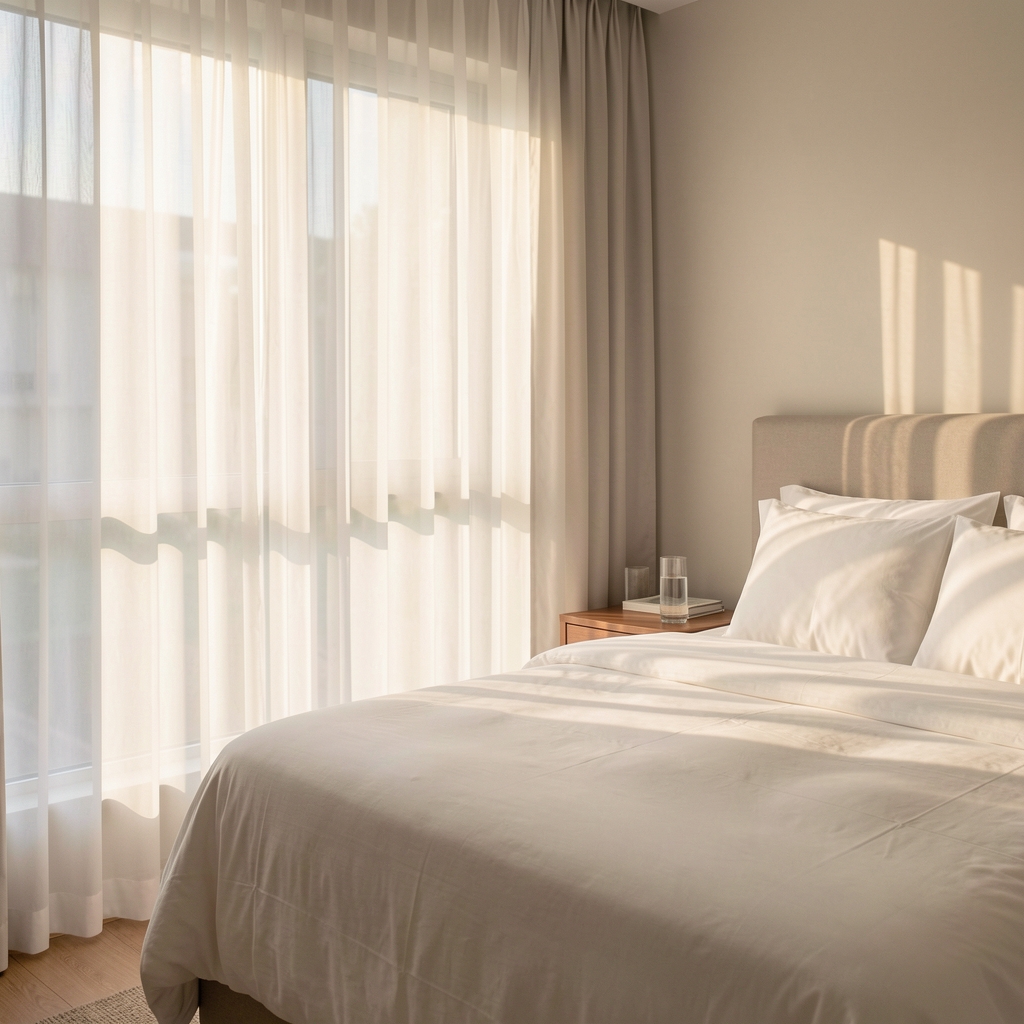
The bedroom is a proposition. Most people accept whatever the room happens to be — whatever the landlord fitted, whatever came with the flat, whatever was left over when the rest of the house was furnished. This is understandable. It is also worth examining. Because the room where a person spends roughly a third of their life, in a state of maximal vulnerability to their environment, is perhaps the one room in the dwelling where the arrangement of conditions actually matters in a measurable way.
This piece documents the variables that consistently appear in published sleep research as relevant to sleep quality: temperature, light, sound, and to a lesser extent, the material and spatial organisation of the room. It is not a shopping list. It is a set of observations about the logic underlying each variable, and what minimal adjustments to that variable tend to produce.
Across the literature on bedroom environment and sleep quality, ambient temperature returns more frequently than any other single variable. The mechanism is straightforward. Core body temperature follows a circadian arc, declining in the hours before and during sleep. The body sheds heat partly through peripheral vasodilation — the widening of blood vessels in the hands and feet that allows heat to escape through the skin. A cooler ambient environment supports this heat-shedding process. A warm one resists it.
The range most consistently cited in the published findings is 16–19°C, with some studies extending this to 20°C for individuals who run cold. This is noticeably cooler than the ambient temperature most people maintain in their living spaces during the day — which tends to sit at 20–22°C. The implication is that most people are sleeping in rooms that are somewhat warmer than is optimal for sleep onset and continuity.
The practical interventions are mundane. Setting the central heating to reduce before the intended sleep time. Opening a window, where the outdoor temperature permits. Using lighter bedding during warmer months, rather than maintaining a uniform duvet weight across the year. None of these require purchase or installation. They require only an acknowledgement that the bedroom temperature, left unmanaged, will default to whatever the rest of the house happens to be.
One detail worth noting: the goal is a cool room, not a cold one. A room that is uncomfortably cold disrupts sleep for the same reason as a warm one — the body is redirecting resources to manage its temperature rather than progressing through the sleep architecture. The target is a range that supports the body's own thermal regulation without requiring it to work against the environment.
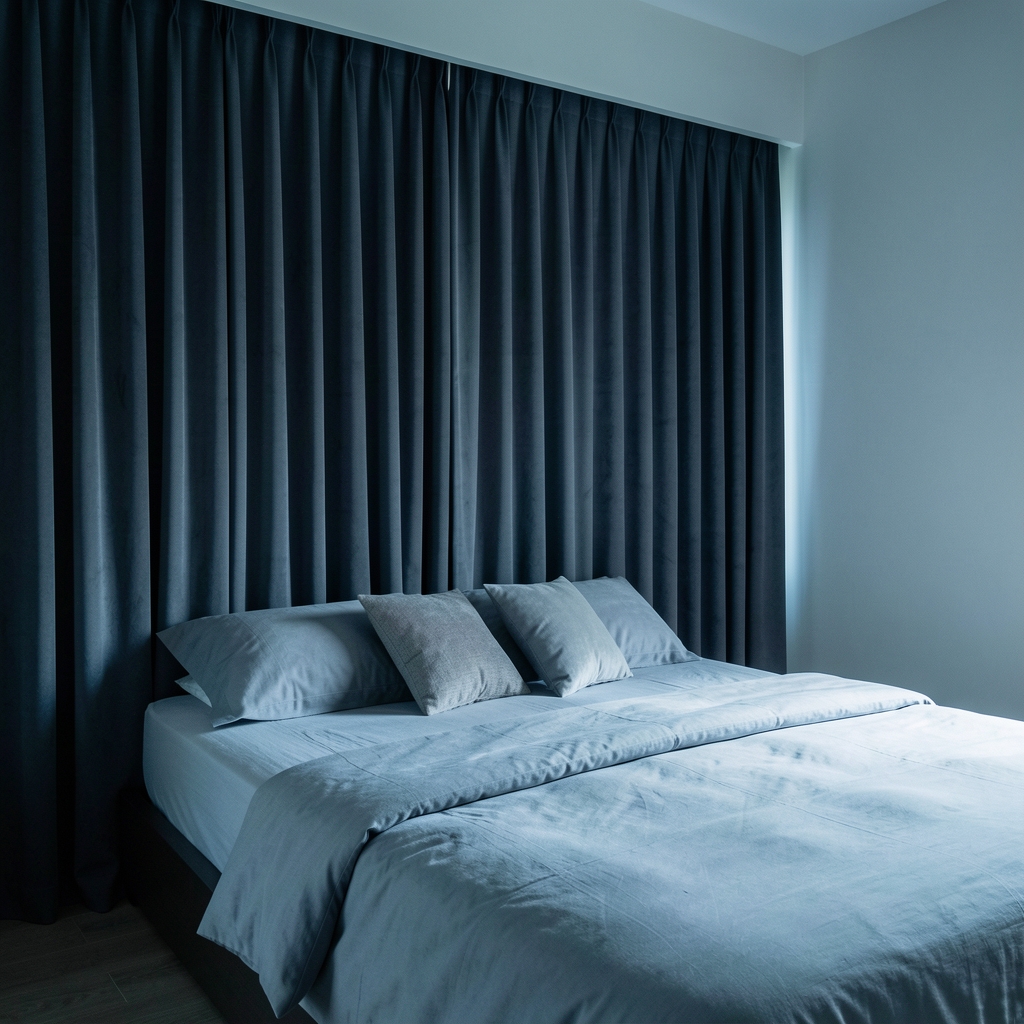
Darkness is not merely the absence of light. It is a condition that the circadian system actively reads. In the absence of light input, a cascade of physiological changes begins — changes that collectively constitute the preparation for sleep. Ambient light, even at relatively low levels, can interrupt or delay this cascade. The bedroom that appears dark to the adapted eye may still be delivering enough light through thin curtains or electronic standby indicators to affect sleep architecture.
Blackout curtains or blackout blinds appear in the sleep research literature more consistently than almost any other specific intervention. The mechanism is not complicated: they prevent the external light environment — streetlamps, passing vehicles, dawn — from entering the room and providing the circadian system with a reason to remain alert. On mornings where natural waking before the alarm is desired, the same curtains that protect sleep can be opened gradually to provide the morning light exposure that advances the circadian clock.
Electronic light sources within the room — standby indicators on televisions, router LEDs, alarm clock displays — tend to be individually small but collectively meaningful. A room that has been equipped with blackout curtains but still glows with several small blue or white indicator lights has partially negated the intervention. The simplest resolution is to relocate devices outside the bedroom, or to cover the indicators with opaque tape.
The well-prepared bedroom is, in the most literal sense, a dark room. Not as austerity, but as physiology.
Sound is frequently cited anecdotally as a sleep disruptor — the partner who snores, the street outside, the upstairs neighbour — but it receives less systematic attention in mainstream sleep discussions than light or temperature. This may be because the interventions are less elegant. Blackout curtains are a design choice; earplugs are a concession. Nevertheless, acoustic conditions in the bedroom have a well-documented relationship with sleep quality, particularly with the frequency of micro-arousals during the night.
A micro-arousal is a brief transition from a deeper to a lighter stage of sleep, often too short to produce a conscious memory of waking. These transitions are normal and occur several times across a typical night. What acoustic disruption does is increase their frequency — producing a sleep that feels, by morning, less restorative than the total hours would suggest. The person who sleeps eight hours in a noisy environment may wake less refreshed than the person who sleeps six hours in a quiet one, not because the quiet environment is more efficient, but because the noisy one is interrupting the restorative architecture more often.
Interventions vary by circumstance. Foam or wax earplugs are the most effective portable solution, reducing ambient noise by 25–35 decibels at the higher end of the performance range. White or brown noise — a consistent, broadband sound that masks irregular peaks — is an alternative for those who find earplugs uncomfortable or who need to remain responsive to their environment (a parent with an infant, for example). Heavy curtains and soft furnishings contribute modestly to acoustic attenuation without the need for worn devices.
Beyond the three primary variables — temperature, light, sound — the spatial character of the bedroom has a more diffuse but still relevant influence on the ease of sleep onset. Research on the psychology of space and rest is less precise than the physiology, but a consistent pattern emerges: the degree to which a person mentally associates the bedroom with sleep — rather than with work, entertainment, or anxiety — correlates with how quickly they fall asleep when they lie down.
This is the basis of the sleep hygiene recommendation to avoid working in the bedroom, to avoid watching television in bed, and to reserve the space primarily for sleep and rest. The argument is not moralistic. It is associative. The brain builds context-associations rapidly and degrades them slowly. A bedroom that is consistently used for a single purpose becomes associated with that purpose, which lowers the cognitive threshold for sleep onset when the person enters the space and lies down.
The practical implication for people who live in smaller spaces — where the bedroom is also the study, the sitting room, the home office — is not that all is lost, but that visual cues matter. A desk that is covered and out of sight when the person goes to bed is less disruptive than one that sits open and lit with notifications. The goal is to give the brain a clear contextual signal that the room has transitioned from one mode to another, even if the physical space has not.
The material conditions of the bed itself — pillow firmness, mattress support, bedding weight — are the most individual of the environmental variables, and the most resistant to general directive. What published research does consistently note is that thermal comfort within the bed, as distinct from ambient room temperature, is independently significant. The bedding that traps too much heat around the body disrupts the core temperature decline that sleep onset depends on.
Natural fibre bedding — cotton, linen, wool — tends to allow more moisture and heat transfer than synthetic alternatives, which is why it appears frequently in recommendations for hot sleepers. The specific firmness of a mattress or pillow is a function of individual body geometry and sleeping position, and the research literature does not support a universal standard. What does emerge is that perceptions of poor mattress or pillow quality are among the most reliably cited contributors to subjectively poor sleep in survey data — suggesting that, even if the precise optimum is individual, the variable is worth attending to.
The bedroom, as a recovery environment, is not a project to be completed over a weekend. It is a set of conditions that can be adjusted incrementally — one variable at a time, over weeks — while observing the effect. This approach has the advantage of making the cause-and-effect relationship visible. If cooling the room by two degrees produces a noticeable improvement in the quality of morning waking within a week, that observation is more instructive than any general recommendation could be.
The room already has a temperature, a light level, and an acoustic character. The question is simply whether these conditions have been chosen deliberately or inherited by default. The difference between the two is not necessarily dramatic. It is a matter of redirecting attention toward a space that most people pass through twice a day without examining.

Tobias Ashcroft is a contributing editor at Oslamin Notebook. His writing examines the material and environmental conditions of rest, drawing on published findings in sleep research and the observation of how spaces are arranged to support or undermine recovery.
More from this publication →